The Claim
The claim has been brought against Apple on behalf of UK domiciled iOS app developers in the Competition Appeal Tribunal (CAT). The CAT is the UK’s specialist court established to hear cases involving competition law and collective damages claims.
Apple is accused of abuse of dominance in the design and implementation of its ATT Policy, which is the company’s framework for allowing users to choose whether an app can track users’ activity across other companies’ apps and websites.
On Apple iPhones, users may be faced with this pop-up when opening an app for the first time. They then have the option to decide whether they will allow the app to track their activity across other companies’ apps and websites.
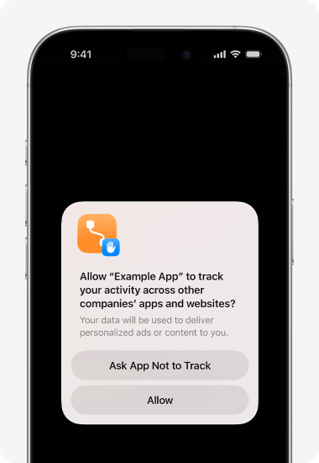
A privacy choice screen (taken from Apple’s Support website)
The claim alleges that Apple designed and implemented ATT in a way that treated third-party app developers unfairly, by being treated less favourably than Apple’s own advertising and data collection activities.
The claim is against Apple on behalf of UK domiciled iOS app developers.
Apple has been accused of unfairly imposing the ATT framework on third-party apps, while applying preferential measures for Apple’s own apps. Such conduct has unfairly disadvantaged third-party app developers.
In the design and implementation of the ATT, third-party app developers are forced to adopt a privacy choice screen that is more restrictive than the terms and conditions Apple imposes on its own data collection.
By contrast, Apple used a substantially different and more limited privacy choice screen.
The claim has been brought by ATT Collective Action Limited (“ATTCA”). ATTCA’s sole director, Ann Pope, is an economist, competition law expert, and former Senior Director for Antitrust at the Competition and Markets Authority. Ann currently serves on the Enforcement Decision Panel of Ofgem, the UK’s gas and electricity market regulator as well as consulting on antitrust matters.
In Ennis v Apple, the CAT saw evidence which indicates that there are over 13,000 app developers in the UK. These app developers may have been affected by Apple’s conduct.
Among them, around 70% of these developers are smaller organisations, which have developed apps with fewer than 100,000 downloads.
Joining the claim
The proposed class includes UK app developers who, between 26 April 2021 and 3 September 2026, generated revenue from advertising within a third-party iOS app and/or spent money on advertising to attract users to a third-party iOS app.
The claim seeks approximately £2 billion in compensation on behalf of thousands of UK app developers who are alleged to have suffered losses as a result of the ATT Policy. Individual compensation amounts will be determined through the legal proceedings. However, many app developers are estimated to have suffered losses in the thousands of pounds.
Nothing.
Funding arrangements are in place which mean that class members will not need to pay anything to participate in the claim. These arrangements also mean that class members will not be exposed to any financial risk even if the claim is unsuccessful.
The claim is funded by TR Global Funding X (Jersey), LP.
These are ‘opt-out’ proceedings, which means that all organisations that fall within the proposed class definition will be automatically represented, unless they actively choose to opt out.
If and when the CAT certifies the case, you will be able to opt-out of the claim.
If you choose to opt out, you will not be able to request payment from future damages or a settlement if the claim is successful.
For now, no evidence is required.
As these are ‘opt-out’ proceedings, all affected app developers will automatically be represented in the claim. You do not have to provide evidence to register for email updates on the case.
In the event of successful proceedings or a settlement, further information will be provided regarding actions you need to take to obtain compensation.
No. The proposed class representative (“PCR”), ATTCA has secured a litigation funding arrangement, which means that proposed Class Members do not face any personal risk in relation to the costs of bringing these proceedings and running the claim through to its conclusion.
Ultimately, this will depend on the court, which in this case is the Competition Appeal Tribunal (CAT). Given the complexity of the issues and the size of the affected class, the action will likely take 4-5 years. This is standard in collective actions.
About Collective Actions
Collective actions are also commonly referred to as a ‘class action’, ‘group claim’ or ‘group action’. They are a type of court procedure in the UK that enable a class representative to bring a legal claim on behalf of a large number of claimants who have suffered loss as a result of a breach of competition law.
Collective actions help level the playing field by enabling companies and consumers to pursue claims against large organisations that might otherwise be difficult to challenge individually. They are particularly useful in cases where pursuing individual claims would be too expensive or time consuming for a business or individual acting on their own. By joining forces, companies and consumers can obtain access to justice and seek redress for alleged breaches of competition law.
A class refers to a group of individuals or organisations with similar legal claims against the same defendant, allowing them to bring a collective action. This typically occurs in cases where individual claims would be impractical or inefficient to pursue separately.
A class member is any individual or entity within this group who is represented in the legal action. Class members do not need to bring separate claims, as a representative claimant acts on behalf of the entire class.
Ann Pope is leading this legal action as the director of ATTCA, the PCR. ATTCA will be pursuing the claim against Apple on behalf of all affected app developers (except for those who decide to opt out). ATTCA will represent the class members before the Competition Appeal Tribunal.
ATTCA is also responsible for keeping class members informed and issuing formal notices, including updates and announcements via this website, email updates for those who register, and written notifications.
As the class representative is responsible for overseeing the proceedings on behalf of the class and acting in the interests of all class members throughout the claim, the Competition Appeal Tribunal must be satisfied that they can act fairly and adequately in the interests of the class, and that they have no conflicts of interest.
Those acting in this role (whether individually or via an entity) have previously come from a wide range of professional backgrounds, some of whom have expertise in consumer rights, trade or competition matters.
Ann Pope, the director of the PCR in this claim, brings more than 30 years of experience in public service, specifically in competition enforcement and consumer protection. Her experience overseeing complex competition investigations and engaging directly with Big Tech provides a strong foundation for representing the interests of class members throughout the proceedings.
The CAT is a UK specialist court, with cross-disciplinary expertise in law, economics, business and accountancy, which hears and decides cases involving competition issues, including collective proceedings. More information on the Competition Appeal Tribunal, including information on its Rules and Guidance, can be found on its website.
Getting and staying in touch with us
If you fall within the class definition, you should register for updates, to receive updates directly at key stages of the claim.
These updates will keep you informed about developments in the claim, and will share information about any action you may be required to take. In the event of successful proceedings or a settlement, this includes telling you what you need to do to receive compensation.
If you have any questions or would like any further information, please contact the proposed class representative’s team at info@appleapptrackingclaim.co.uk.
For any media enquiries, please contact: pope@thorndonpartners.com.