Apple is facing a £2 billion legal action on behalf of thousands of UK app developers. The claim alleges that Apple's App Tracking Transparency (ATT) framework was designed and implemented unfairly causing financial losses to UK app developers.
If you are an app developer who had an app on the Apple App Store since April 2021, you may be entitled to compensation if the claim succeeds.
This legal claim argues that ATT was introduced unfairly without consulting developers, leading to substantial losses.
Although Apple presents itself as a champion of user privacy, it did not apply the same restrictions to its own apps as it required of third-party developers.
The claim alleges that Apple abused its dominant position as the gatekeeper to the App Store, harming thousands of businesses that rely on the platform.
Director of the Proposed Class Representative, ATT Collective Action Limited
Ann Pope is an economist and competition law expert who has spent her career working in UK antitrust law.
She has more than 30 years of experience in competition and consumer enforcement, beginning her career at the Office of Fair Trading, the predecessor to the Competition and Markets Authority (CMA) in 1988.
Between 2014 and 2024, she was the CMA’s Senior Director for Antitrust, leading the competition watchdog’s investigations into firms’ abuse of market dominance.
Learn More.

Apple's practices affected developers across the UK and Europe.
Updates on the claim, the law, and what it means for UK app developers.
The claim has been brought against Apple on behalf of UK domiciled iOS app developers in the Competition Appeal Tribunal (CAT). The CAT is the UK’s specialist court established to hear cases involving competition law and collective damages claims.
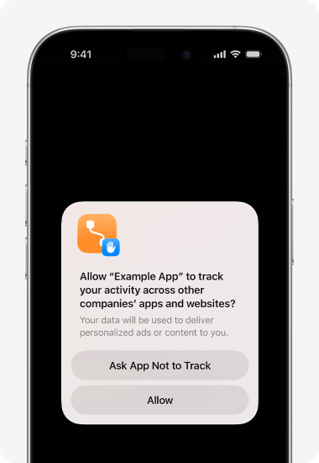
Apple is accused of abuse of dominance in the design and implementation of its ATT Policy, which is the company’s framework for allowing users to choose whether an app can track users’ activity across other companies’ apps and websites.
On Apple iPhones, users may be faced with this pop-up when opening an app for the first time. They then have the option to decide whether they will allow the app to track their activity across other companies’ apps and websites.

A privacy choice screen (taken from Apple’s Support website)
The claim alleges that Apple designed and implemented ATT in a way that treated third-party app developers unfairly, by being treated less favourably than Apple’s own advertising and data collection activities.
The claim is against Apple on behalf of UK domiciled iOS app developers.
In Ennis v Apple, the CAT saw evidence which indicates that there are over 13,000 app developers in the UK. These app developers may have been affected by Apple’s conduct.
Among them, around 70% of these developers are smaller organisations, which have developed apps with fewer than 100,000 downloads.
If you or your organisation are a UK-based iOS app developer, and have generated revenue from advertising within a third-party iOS app and/or incurred expenditure on advertising to acquire users for a third-party iOS app between 26 April 2021 and 3 September 2026, you could be entitled to compensation.